

Yes, often you can. Being in your final year does not automatically mean waiting for your degree certificate before applying. Universities may assess your available marks, course fit, references and statement, then make an offer conditional on your final results. The exact documents and conditions depend on the course.
For example, Trinity College Dublin's postgraduate application FAQ says final-year applicants may upload their most recent transcript and can receive a conditional offer pending final results. Oxford's transcript guidance also explains how current students can submit an interim transcript. These examples show a route exists; they do not guarantee admission at every university.
For example, Trinity College Dublin's postgraduate application FAQ says final-year applicants may upload their most recent transcript and can receive a conditional offer pending final results. Oxford's transcript guidance also explains how current students can submit an interim transcript. These examples show a route exists; they do not guarantee admission at every university.
What you can prepare before graduation
Start with a shortlist of courses, not only universities. Compare modules, entry requirements, tuition, location and how each programme supports your career direction. The UK postgraduate application guide notes that requirements vary by course and that many applications go directly to the university.
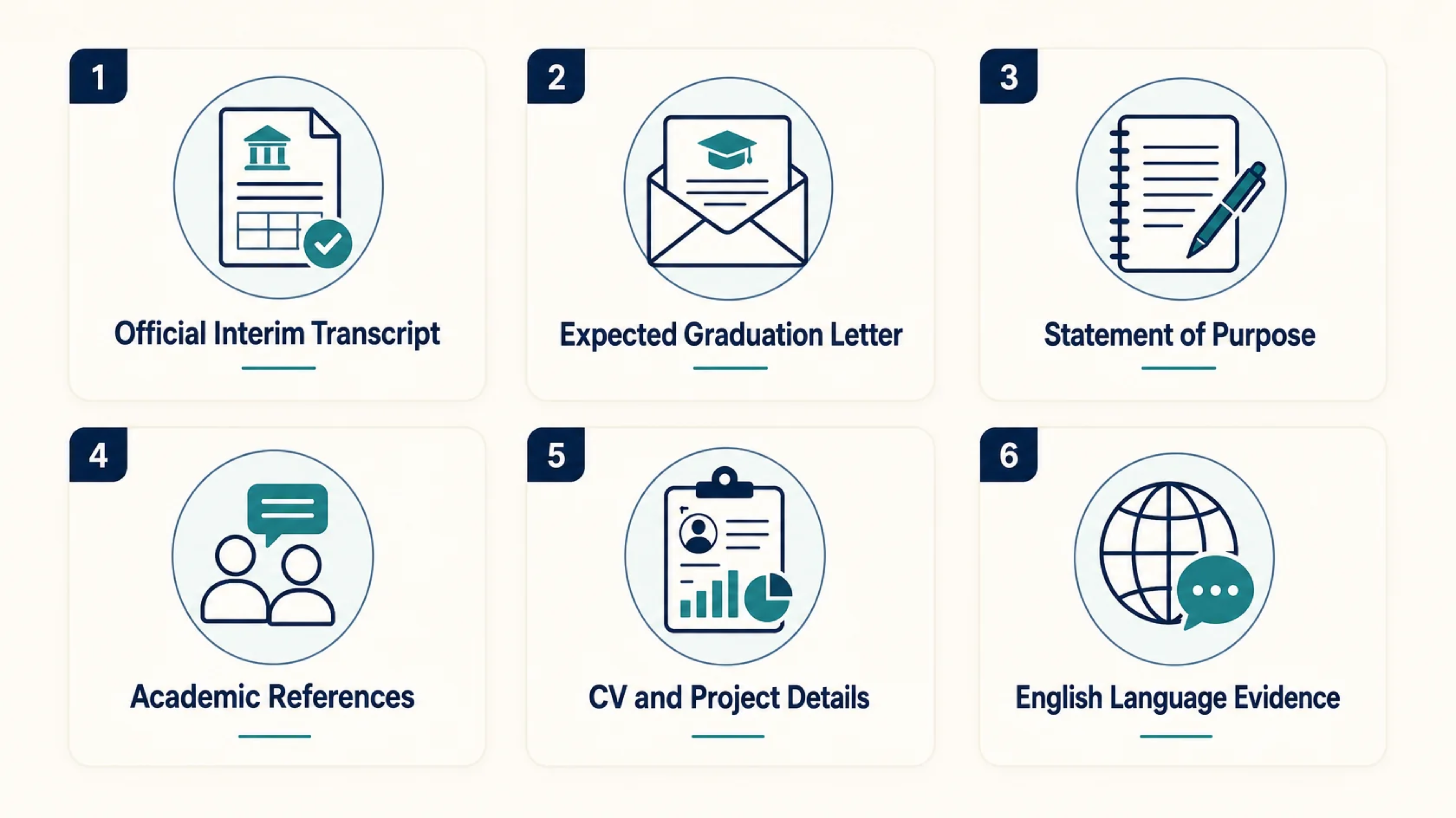
Create one folder with:
- Your most recent official transcript or semester marksheets.
- An expected-graduation letter or enrolment confirmation, if the university asks for one.
- A course-specific statement of purpose or personal statement.
- Your CV, relevant projects and internships.
- Referee contact details, with the referees' agreement in advance.
- English-test evidence if required, or a realistic date to supply it.
- Passport details in the format requested by the application portal.
Do not upload a self-made "final" transcript. If a university needs a document you do not yet have, ask admissions whether an interim version is acceptable and record its reply.
How a conditional offer works
A conditional offer tells you what must happen before your place is confirmed. It might require a final degree result, an English score, a verified transcript or another item. Read the exact wording and due date on your offer. An offer is not a waiver of its conditions, and you should not assume a deposit is refundable if you cannot meet them.
The useful question is not simply "Can I apply now?" It is "Can I meet every condition in time for this intake?" Map your university's result date against the overseas university's document deadline, deposit date, visa preparation and course start. If the gap is too tight, a later intake may be safer.
The useful question is not simply "Can I apply now?" It is "Can I meet every condition in time for this intake?" Map your university's result date against the overseas university's document deadline, deposit date, visa preparation and course start. If the gap is too tight, a later intake may be safer.
A practical final-year sequence
1. Now: choose a field and compare courses using module lists and entry criteria. Start the UK course guide or Ireland course guide as background, then verify the university's own page.
2. Before applying: request your official interim transcript and academic references. Draft a separate statement for each course; the UK SOP guide can help you structure it.
3. After applying: keep an application tracker with portal login, outstanding document, deadline and admissions contact.
4. After an offer: confirm the conditions, final-document route and deposit policy in writing before committing money.
5. After results: send the final evidence through the university's approved method, then follow its visa and enrolment instructions.
Build a shortlist that respects your result date
Suppose your final semester exams finish in May but your college normally releases results in August. A course starting in September may still be possible, yet the question is whether that university accepts final evidence in time for its own enrolment and visa process. Write those dates beside every programme. If one university needs a completed degree in July and another will accept the final record later, they are not equally realistic options for you.
Use three labels in your tracker: ready to apply, ask admissions, and unlikely for this intake. Put a programme in the second group whenever the website is unclear about provisional records, English evidence or final-document timing. A short question to admissions is better than guessing. Keep the reply so you can refer to it if the portal instructions differ from the general course page.
Your shortlist should also include at least one option that fits your demonstrated academic record and budget. Applying to only high-entry courses or only the cheapest courses can leave you with choices that do not suit your goal. Look at the actual modules and assessment style. For example, a data science applicant should check whether the programme expects prior coding and statistics rather than relying on the degree title.
What to say in your statement while still studying
Describe what you have completed, what you are currently studying and what you expect to finish before the course begins. Name a relevant project or internship and explain the skill it demonstrates. If your final-year project is unfinished, say what problem you are tackling and what you have done so far; do not present expected results as completed achievements. This makes the application credible and gives the reviewer a clear picture of your readiness.
Ask your referees to comment on observed work, not predicted grades they cannot support. If the university requires a reference on institutional letterhead or from an official email address, tell the referee early. Small administrative gaps often cause more delay than the statement itself. Keep a final copy of every version you submit so you can prepare for an interview or answer a later document query consistently.
Ask your referees to comment on observed work, not predicted grades they cannot support. If the university requires a reference on institutional letterhead or from an official email address, tell the referee early. Small administrative gaps often cause more delay than the statement itself. Keep a final copy of every version you submit so you can prepare for an interview or answer a later document query consistently.
Common questions
• Can I apply with five or six semester marksheets?
— Possibly. Use the most recent official record you have and follow the programme's document instructions. Ask admissions if the exact format is unclear.
• Does a conditional offer mean admission is guaranteed?
— No. It depends on meeting every stated condition by the university's deadline.
• Should I wait for my degree certificate?
— Not necessarily. Waiting can reduce your course options, but applying early helps only if you can deliver the final documents on time. Check the programme and your college's result schedule together.
Related StackLearn guides

• UK SOP guide
• Ireland course guide
If you are in your final year, StackLearn can help you build a realistic course and document timeline. Its overseas education consultancy fee is ₹0; external university, test and visa charges remain separate. Contact StackLearn with your current semester, expected result month and preferred subject for a shortlist review.